Architecture does not necessarily begin with a façade. For Eileen Gray, it begins with the question of how a person moves through a room, where they put things, how light and furniture change everyday life. Her houses and furnishings therefore resist neat classification as either architecture or design. This is not an art-historical refinement applied after the fact, but a method: life first, then form.
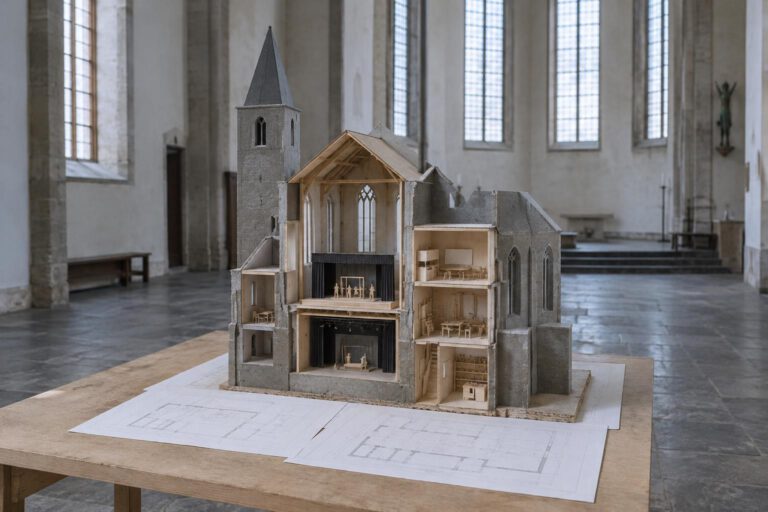
Marking the fiftieth anniversary of the designer’s death in 1976, the exhibition “Eileen Gray: Golden Girls No. 3” at Museum Pfalzgalerie Kaiserslautern strikes an apt note. Running until 8 November, it presents designs, drawings and selected objects within an exhibition design that translates her work into spatial terms. A large model and spatial configurations make the act of interpretation itself a subject: how can architecture be exhibited when its essence lies not just in its outward form, but in the relationship between space and use?
The house as a movable arrangement
Born in Ireland in 1878, Gray initially worked with lacquer, furniture and interiors. In the late 1920s, she designed the house E.1027 on the Côte d’Azur for Jean Badovici. The house is regarded as a key work, but not because it placed a new icon of white modernism in the landscape. What matters is how it accommodates its inhabitants: with built-in and movable furniture, adaptable transitions and a layout that does not treat comfort and intimacy as fittings to be added later. Here, architecture is not a neutral shell that can be furnished at will. It emerges through its interplay with the things people use.
This is what makes Gray relevant today. There is much discussion now of flexible floor plans, multifunctional furniture and adaptable homes, often as a response to limited space and changing ways of life. For Gray, flexibility is more than a technical promise. It begins with close observation of everyday life: what does a person need in order to use a space on their own terms? A movable object can then be more than an elegant detail – it changes how the space works.
The model is not the house
The Kaiserslautern exhibition opts for translation rather than mere illustration. The model conceived by RPTU’s Faculty of Architecture and Anna Viebrock’s scenographic work offer different approaches to Gray’s spatial ideas. A model reduces scale, imposes order and makes connections visible; a walk-through installation, by contrast, can bring scale and the body back into play. Both offer insights, but both are also selective: no model can replace the site, no stage set the experience of living.
This limit matters. The seductive power of scenography can make architecture appear as atmosphere, while construction, materials, commissions and costs slip from view. How a house is actually used is determined not only by its form, but also by who can build and inhabit it. Gray offers no ready-made answer to this for housing today. Rather, her work sharpens the question of whether design genuinely makes everyday life easier – or merely conjures an image of a better life.
Beyond the divide
Art-historical recognition of Gray must also do more than retrospectively add an overlooked woman to a roll call of great names. That she was long less prominent than some of her male contemporaries is part of the history of her reception; MoMA was already describing her marginalisation at a retrospective in 1980. Yet this correction should not give rise to a new legend in which one individual effortlessly transcends every discipline. Gray worked within specific relationships, under the conditions of her time, and produced a body of work that cannot be reduced to a single house.
This is precisely why a focus on use and everyday life is more than an appealing addition to architectural history. It shifts the terms of judgement: away from asking which object counts as an autonomous masterpiece, towards asking how things and spaces work together. In Kaiserslautern, this shift becomes the subject of the exhibition. Seeing models and spatial fragments there is not the same as living in a house. But it makes a productive distinction visible: architecture is not just what stands. It is also what people can do within it.
Original reviewed by the editors · 3 November 2026