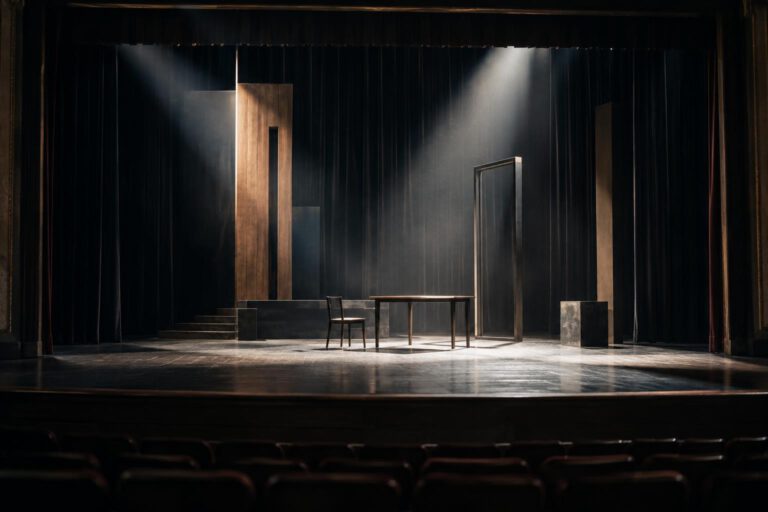
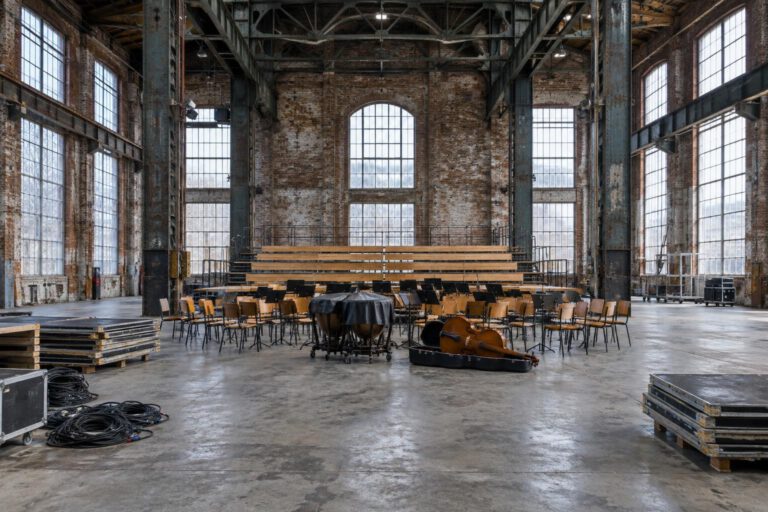
A set design cannot simply interpret a classic as though it were a thesis. But it can determine what we look at: a body losing its way in space, a family closing itself off, or an order that can no longer conceal its own cracks. In ‘Hamlet’, this question is particularly acute. Who rules in Denmark, who watches and who remembers have been part of the play’s political architecture since Shakespeare.
A new version opens at the Berliner Ensemble on 5 November: Ersan Mondtag directs and designs the set, while Wilke Weermann is responsible for the adaptation. The theatre announces a focus on the self-destructive forces of a society that carries within it the contradictions of a world order founded on violence. How the set will translate this idea into concrete form remains an open question ahead of the premiere. Yet the combination of direction and set design already makes the space more than a backdrop.
A space is not an outside commentary
Shakespeare’s tragedy does not treat its setting merely as a background. Elsinore is a court, a family unit and a state in crisis. News of the king’s death, the queen’s new marriage and the return of his ghost entwine private life with public power. A set design can separate these layers — by isolating characters, for example — or bring them into collision. It can show who has access to whom, who is put on display and who evades scrutiny.
This is a possibility, not a prediction for Mondtag’s production. The Berliner Ensemble has released no advance details of specific scenery or changes of space. What is certain is that Mondtag is responsible for both the direction and the set. The team includes Josa Marx on costumes, Robert Lippok on music, Alexander Pannier on video and Hans Fründt on lighting. This identifies various means by which a production can structure space; only the performance will reveal how they work together.
When the image puts pressure on the text
Mondtag’s work moves between theatre and visual art. In 2024, he was one of the artists involved in the German pavilion at the Venice Biennale; the Berliner Ensemble describes his productions as visually powerful and notes that he often designs his own sets. A feature by Deutschlandfunk Kultur also explores his movement between the arts and his forthcoming work on ‘Hamlet’. This transition is not merely a question of aesthetics. A set design can assert a time of its own while the text evokes another; it can offer a metaphor that performers embrace, subvert or play against.
In ‘Hamlet’ especially, the image should not solve every riddle. The prince wavers between duty, doubt and the desire to put a disjointed order right. If the space becomes too unambiguous, the tragedy risks becoming an illustration. If, on the other hand, it remains arbitrary, it contributes little to the interpretation. The productive relationship lies somewhere between the two: a spatial proposition gives the characters something to push against without prescribing their every movement.
What the space leaves to the performance
The cast brings together members of the Berliner Ensemble: Sebastian Zimmler plays Hamlet, Pauline Knof Gertrude and Marc Oliver Schulze Claudius. Pierre Emö takes on Ophelia and Fortinbras. This doubling is another of the production’s decisions announced in advance; what significance it will acquire as the performance unfolds cannot yet be said. It can, however, remind us that theatrical roles are not positions ordained by nature, but are created through bodies, costumes and gazes.
Ultimately, then, what matters will not only be what stands on stage, but what happens there between space and performance. The stage space is free to shift Shakespeare’s ‘Hamlet’, narrow it or read it against its familiar images. It may contradict the text. But it must give the performers something to do — and leave enough open for the audience to form its own judgement. Mondtag’s premiere sets precisely this question in motion; its answer remains unwritten until the curtain rises.
Original reviewed by the editors · 4 November 2026