An architecture museum does not necessarily collect buildings. The S AM Swiss Architecture Museum in Basel has no conventional collection; it presents architecture in temporary exhibitions and must decide which spaces, images and narratives will make it intelligible. Since January 2026, the museum has been led by Adam Szymczyk, a curator whose career has been shaped by art institutions and major exhibitions. What changes when this perspective meets architecture?
An initial answer comes from the exhibition ‘Tony Fretton: Practice’, on view at S AM until 3 January 2027. It focuses on selected projects by the London architect and, according to the museum, was developed in close collaboration with him. This is not yet a radical change of programme, but it provides a clear setting for Szymczyk’s central question: how can architecture in a museum be not merely represented, but explored as a spatial experience?
Space Is Not Neutral
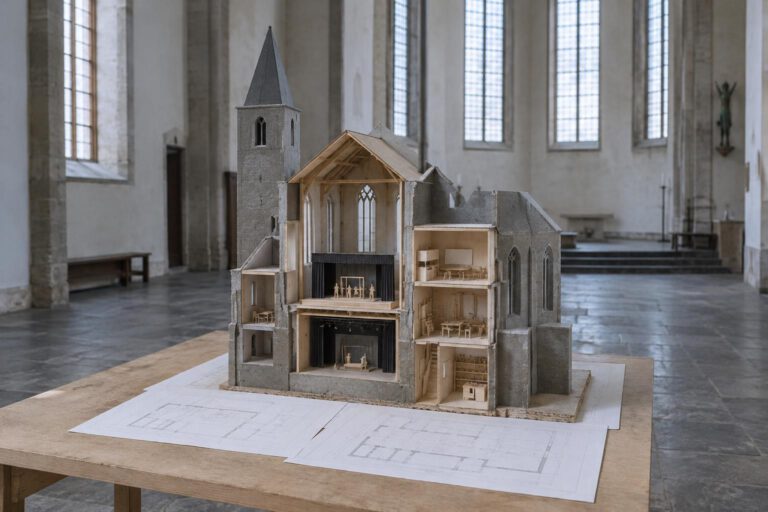
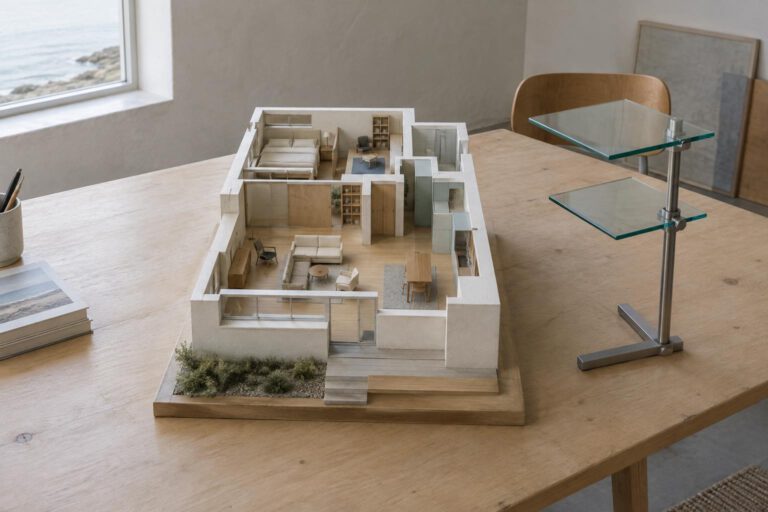
In an October interview with BauNetz, Szymczyk described exhibitions as spaces that organise perception through movement, distance, transparency, material and atmosphere. At first, this sounds like a curatorial truism. In an architecture museum, however, it becomes tangible. Models, plans and photographs always convey buildings from a particular perspective; the exhibition determines what becomes visible at scale and what remains outside the frame.
Szymczyk comes from contemporary art. He directed Kunsthalle Basel from 2003 to 2014, co-curated the 5th Berlin Biennale in 2008 and was artistic director of documenta 14 in Athens and Kassel in 2017. His experience thus lies in placing works and ideas in public contexts. For S AM, this does not automatically mean mixing architecture with art. In the interview, he challenges precisely this separation: the two fields, he argues, share a cultural history; what matters more is making their existing proximity visible.
From the Swiss to the Transnational
The museum’s name, too, becomes a subject of enquiry for him. S AM is a Swiss museum because it is in Basel, he says, but not a museum devoted exclusively to Swiss architecture. The transnational perspective Szymczyk proposes is therefore more than a geographical expansion. It raises the question of who writes architectural history and which political or cultural connections disappear within a national narrative.
This suits an institution whose own history is linked to a specific decision about a building: the museum was founded in 1984 to save Basel’s Domus-Haus from demolition. Since 2004, it has occupied the Kunsthalle building on Steinenberg. Here, architecture appears not only as a finished object, but as a dispute over preservation, use and public value. In the conversation, Szymczyk also emphasises the museum’s political, economic and social history. This is an ambition against which future exhibitions will have to be measured.
Everyday Life as a Measure
He himself cites a concrete example of this kind of opening up: S AM’s earlier exhibition on Swiss housing cooperatives. The subject appealed to people who did not regularly visit architecture exhibitions because it touched on their own housing circumstances. The crucial point is not simply to choose a popular subject. Szymczyk speaks of a political stance that should unfold through the programme over time – and of a museum that enables debate rather than laying down truths with authority.
After only a few months, it is too early to judge conclusively whether this will produce a discernible new direction. ‘Tony Fretton: Practice’ is a monographic exhibition, not evidence of a wholesale change of course. Yet Szymczyk’s questions shift the terms of assessment: it is not only about which buildings are shown, but also how exhibitions and institutions organise knowledge.
The Test in Lagos
From 16 to 18 November, Szymczyk will lead the Lagos Biennial’s three-day Curatorial Lab. According to the announcement, the programme aims to question inherited exhibition models and rethink the museum, the exhibition and the canon. Discussions, site visits, presentations and workshops are planned. This is not an architecture exhibition, but it continues the same fundamental curatorial question: how can exhibitions generate new knowledge rather than merely present existing histories?
Basel and Lagos are not interchangeable stops along the way. The Lab takes place in a different institutional and social context and is aimed at early- and mid-career curators. Nevertheless, it offers an illuminating connection to Szymczyk’s work at S AM: anyone exhibiting architecture shows more than buildings. They also decide which experiences count as knowledge and who features in it. The real change will become apparent in whether these questions take lasting shape in the Basel programme – in its subjects, its spaces and the people the museum reaches.
Original reviewed by the editors · 3 November 2026