A body is never entirely alone. Microscopic organisms live on its skin, in its gut and in the fluids that flow through it; at the same time, the body is a resonant space that receives and transmits vibrations. The exhibition “Inter Acting Buggy Worlds” takes these barely visible relationships as its starting point. From 5 November, Mel e Logan brings together paintings, video projections and interactive sound sculptures in the Sala Terrena of Vienna’s Heiligenkreuzerhof.
The Galerie der Angewandten describes the works as the result of an engagement with bodily fluids and acoustic activation. Logan combines artistic practice with scientifically inspired motifs without turning the exhibition into a laboratory in the strict sense: the advance information suggests an emphasis on imagination, translation and playful connections. Its title promises not seamless unity but an interplay of worlds that touch and transform one another.
Microbes as fellow participants
What escapes our notice in everyday life takes on possible forms through images and sounds. In the university gallery’s announcement, gut bacteria appear as fantastical birds, while microscopic Demodex mites acquire a human-like appearance. One of Logan’s exhibited paintings, “Anthropomorphized Demodex”, is listed as acrylic on canvas. This transformation is not a scientific depiction. Rather, it shifts the perspective: the human being appears not as a sovereign centre but as a habitat shaped in part by other organisms.
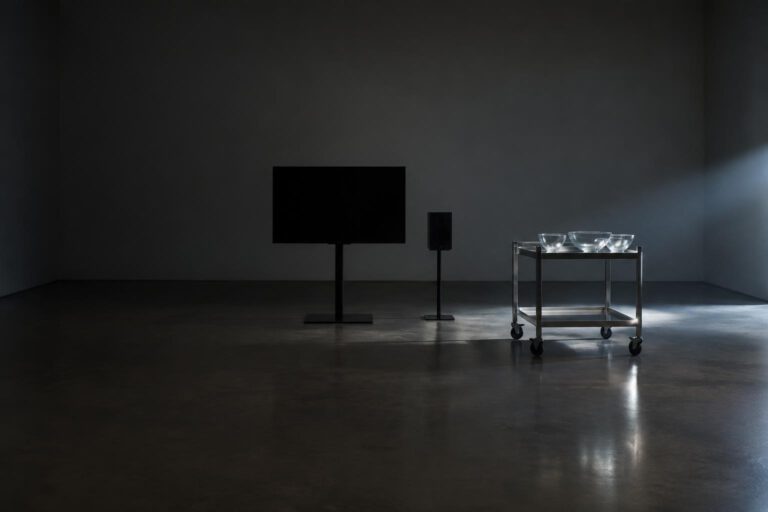
The announced media also include interactive sound sculptures that visitors can activate via antennae or theremin-like sound devices. This makes the audience more than observers standing before the works. Visitors are invited to bring movements and sounds into the exhibition — a form of involvement that touches on a central question: who sets the terms of the experiment here? The artist devises situations, yet their activation also depends on the people in the room. This is a different notion of participation from simply pressing a button: the audience becomes part of an experimental arrangement whose outcome is not entirely predetermined.
Art and research: an unequal division of labour
The exhibition draws on a tradition that the Angewandte associates with the “salon” and with artistic activities influenced by scientific research. Such encounters between art and science do not automatically take place on equal terms. Research can supply art with findings, methods and concepts; art can translate or shift these, or strip them of their apparent certainty. Who takes on which role remains a question to be tested against the actual works — one that a preview cannot answer conclusively.
The title “Inter Acting Buggy Worlds” also suggests disruption and movement: “buggy” can evoke errors or malfunctions, while “interacting” denotes mutual influence. In the constellation Logan is preparing, organisms, technical devices and people do not seem neatly separated from one another. What matters, then, is less whether art illustrates research here than how it changes the direction of its gaze: what counts as a subject with agency, and what is usually relegated to mere surroundings?
A space for open connections
The exhibition is being developed with numerous artists and collaborators, including Sonja Bäumel, Jana Saleh, Julie Jebeile, Charlotte Jarvis and Bela Borsodi. This broad collaboration suits a subject that calls the isolated individual body into question. Yet only a visit will reveal how the paintings, projections and sound objects relate to one another spatially, and whether their different languages form a coherent picture.
The opening takes place on 4 November at 6pm; the exhibition runs from 5 November 2026 to 7 January 2027 at the Universitätsgalerie der Angewandten, Sala Terrena, Heiligenkreuzerhof, staircase 7, ground floor. “Inter Acting Buggy Worlds” invites us to think of the body not as a self-contained experimental subject but as a node in a web of relationships. How far that invitation takes us also depends on which connections the audience actually activates in the space.
Original reviewed by the editors · 1 November 2026