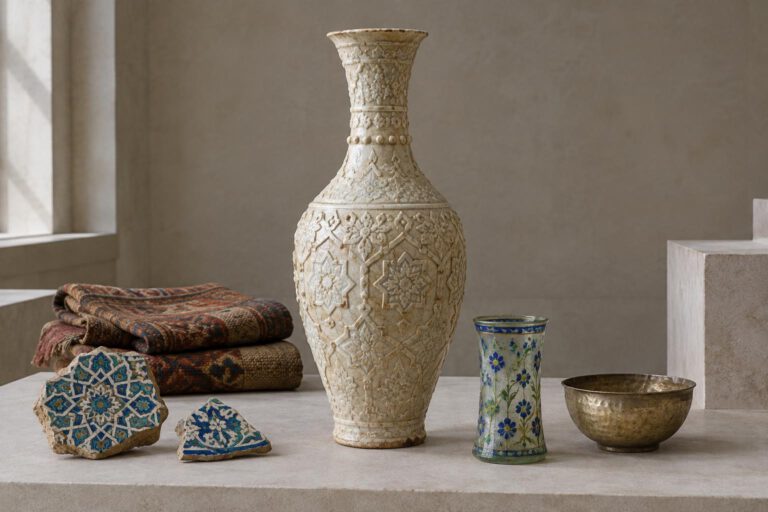
The fragment of a vase from Sevilla announced by Museum Folkwang for its forthcoming exhibition stands 129 centimetres tall: glazed earthenware with stamped relief decoration, made between the second half of the 12th and the first half of the 13th century. This vessel alone shifts the scale. This is not about a decorative footnote to painting, but an artistic cosmos in its own right.
“Nach Damaskus … Karl Ernst Osthaus und die islamischen Künste” (To Damascus … Karl Ernst Osthaus and the Islamic Arts) will be on view from 6 November 2026 to 21 February 2027 at Museum Folkwang in Essen. Around 340 objects have been announced. The exhibition’s significance extends beyond the rediscovery of a collection: what world did the museum’s founder make visible by selecting objects, bringing them together and declaring them art?
Before modernism, for modernism
The museum dates the first acquisitions of Islamic art to 1898. They preceded the purchase of the now celebrated paintings by Renoir and van Gogh. The Werkbundarchiv – Museum der Dinge describes Osthaus’s early interest in decorative arts from Morocco, Tunisia and Turkey. At the Folkwang in Hagen, which opened in 1902, such acquisitions were brought together with modern art and natural history collections.
Osthaus himself described this trajectory as a change in his way of seeing. In his autobiographical account, he recounts how his interest in travelling for natural scientific study developed into an engagement with art and architecture. On his return, even his own museum building, already under construction, no longer satisfied him. It is a revealing self-interpretation: encounters with other cultures appear here as an impetus to renew design at home.
According to the Folkwang, the collected objects were not intended solely to inspire artists. The region’s silversmiths and textile and ceramics industries were also meant to learn from them. Osthaus was thus not assembling a neutral survey of a region of the world. He was also seeking standards for a different present at home.
Who orders the world?
Here lies the productive tension of this preview. Recognising craft as an equal could loosen the boundaries of the European conception of art. Yet selecting it as a model for domestic industry tied it to European needs. The question must therefore be not only which forms enthused Osthaus, but also what knowledge of their making, use and meaning travelled with them.
Even the open presentation across categories has a prosaic backstory. According to the museum, decorative and fine arts were initially displayed together in Hagen partly for financial reasons; only later did this become a hallmark of the institution. The grand museum vision thus also depended on practical circumstances. Details such as these could make the founder’s story more interesting than a simple tribute to his foresight.
The historical designation “Islamic Department” also deserves attention. What distinctions between regions, centuries, religious and secular uses could this classification accommodate, and which did it obscure? A shared collection title does not in itself explain the relationships between objects.
Origins, not just inspiration
The Folkwang has announced comprehensive scholarly research and conservation work. It also reports that around 2,000 pages of historical material have been examined for a pilot provenance research project. The crucial question will be which specific routes taken by the objects can thereby be traced: through dealers, previous owners and the circumstances of acquisition. The volume of documents examined alone does not answer these questions.
Also planned are juxtapositions with Matisse, Peter Behrens, Johan Thorn Prikker and Bruno Taut, as well as a textile installation by Dana Awartani. This promises to open up the story beyond Osthaus. The exhibition will become interesting where it treats the Islamic arts not merely as inspiration for European innovators, but makes their own contexts visible. What could then be discovered is not only the collector’s world, but also what his gaze selected from it.
Original reviewed by the editors · 30 October 2026