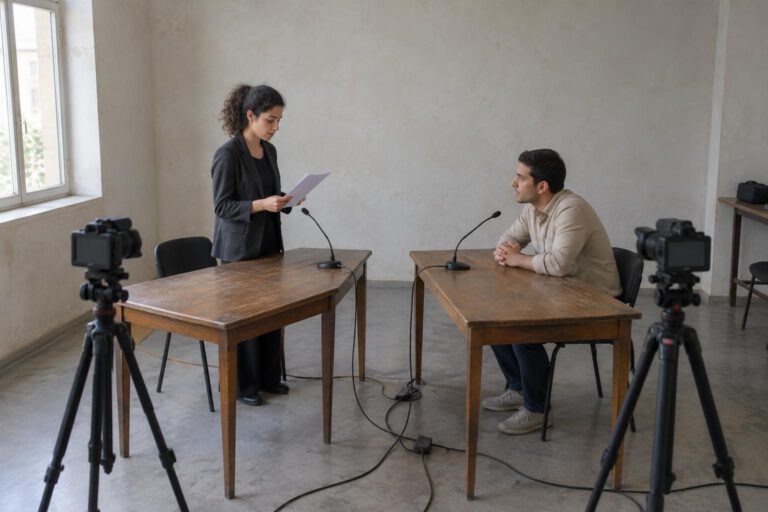
A courtroom, a bank, a case – yet no trial that ever actually took place. For ‘for the record’, Gabriela Löffel develops a fictional legal dispute with legal specialists, journalists and students. In the dock is an invented Swiss bank, the Swiss Trust Bank; the case is staged and filmed in Beirut as a mock trial with law students. The video work forms part of Löffel’s exhibition ‘Grammatik der Lücken’ (Grammar of Gaps), which opens on 15 November at Kunsthalle Appenzell.
The subject touches on real political and economic contexts: the collapse of the Lebanese banking system and possible connections to the Swiss financial sector. The exhibition cites investigations into the case of former Lebanese central bank governor Riad Salamé as starting points. The artistic construction is not, however, a verdict on him or any other real individuals involved. Rather, its invented trial asks how responsibility can be addressed across borders at all – and what happens when complex financial structures are translated into the clear form of legal proceedings.
Legal proceedings as an artistic tool
Löffel works with a form that does not fuse documentary research and staging into a seemingly unequivocal truth. According to the Kunsthalle, she draws on archive material and journalistic investigations for ‘for the record’. The fictional bank turns this into a case that can be presented and discussed without claiming to be a real court file. The filming location, too, remains part of the construction: Forest Studio Beirut is visible as a film studio – a place where a trial is built, just as financial systems rest on largely unseen infrastructures.
The multichannel video work is among the artist’s more recent pieces. Its title already alludes to the act of recording: ‘for the record’ can mean a statement for the files, but also a claim to set something down. Löffel shifts that claim. When proceedings are invented, not every sentence becomes evidence; at the same time, fiction can reveal which questions the customary language of files, jurisdictions and evidence leaves unanswered. This is where the work’s tension lies: it must make the boundary between documented material and artistic invention clear if its construction is not itself to be mistaken for an assertion of fact.
Who speaks – and what remains audible?
This question runs through Löffel’s audiovisual works. Born in 1972 and based in Genf, the artist researches places where power is organised and communicated: military training grounds, financial conferences and film studios, for example. ‘Setting’ (2011) addresses the staging of war and its representation in the media, drawing on accounts by former extras at a US training ground. ‘Unseen’ (2016) looks at the architecture of exhibition stands at the Sibos financial conference in Genf and at how visibility is directed there.
In ‘Grammar of Calculated Ambiguity’ (2024), specialists in politics, law, journalism and linguistics reconstruct unintelligible passages from an audio recording of an offshore finance conference – in a recording studio. This description alone makes clear how central not only the image but also the voice is to Löffel’s work: who is allowed to speak, who is understood, and what roles do translation, pauses and disruptions play? Accordingly, the Kunsthalle describes the exhibition as an investigation into the political and economic power that operates through language, spaces and technical systems.
The gap between file and narrative
The German exhibition title ‘Grammatik der Lücken’ centres not on a single revelation, but on the conditions under which connections become legible. A gap can mean missing information; but it can also arise where different institutions, languages or interests meet. Löffel’s methods – research, translation, montage and staging – expose such points of transition without automatically resolving them.
The exhibition brings together works from two decades and runs until 11 April 2027. ‘for the record’ will also be on view; whether and how the installation brings its individual voices, images and layers into relation within the Appenzell space cannot be judged before the opening. The announced work is already intriguing as an experimental set-up: an invented trial is not intended to replace real justice. Rather, it reveals how art can reconstruct legal proceedings in order to make the language and limits of proof its very subject.
Original reviewed by the editors · 26 October 2026