A dead father leaves behind not only grief, but a task. In Shakespeare’s ‘Hamlet’, the ghost of the dead king demands that his son avenge him. But whose authority does this voice invoke? That of the murdered man, the father, the former ruler? The premise already links a private bond to a political claim: the son must act because the past demands it.
At the Berliner Ensemble, even the author credit now sends a signal: ‘Hamlet’ by William Shakespeare / Wilke Weermann. Ersan Mondtag directs the production, whose premiere is announced for 5 November 2026 at 7.30pm in the Großes Haus. The slash raises a question: what comes from the inherited play, what does the contemporary adaptation set against it — and what is only decided in the directing?
The prince is not automatically in the right
The theatre’s announcement suggests a perspective that does not take Hamlet for granted as the moral counterweight to a corrupt world. Instead, it asks why the son believes that violent retribution on behalf of the old patriarch can also put history right. Mondtag and Weermann thus turn their attention to a society whose violent order unleashes the forces of its own destruction.
This shifts the focus from the famous hesitation to the claim to act. Not just: why does Hamlet do nothing? But also: what entitles him to make his own hurt the yardstick for an entire political order? For now, this is the announced reading, not an assessment of the performance. It would be interesting to see whether the production also leaves room for the contradiction: a justified objection to injustice does not necessarily produce a just response.
Three levels of responsibility
Shakespeare offers no unambiguous instructions here. His prince must test whether the apparition can be trusted. The injunction to take revenge thus comes with no reliable proof of its truth. This uncertainty is part of the dramatic conflict; it is not merely a contemporary addition.
Weermann’s contribution evidently goes beyond simply adapting the text for the stage. In a conversation with Elke Buhr published in September for the Monopol podcast, Mondtag described the work as a rewriting. The available information does not, however, establish which passages have been retained, replaced or rearranged. The joint author credit makes the contemporary intervention visible, but does not yet reveal its extent.
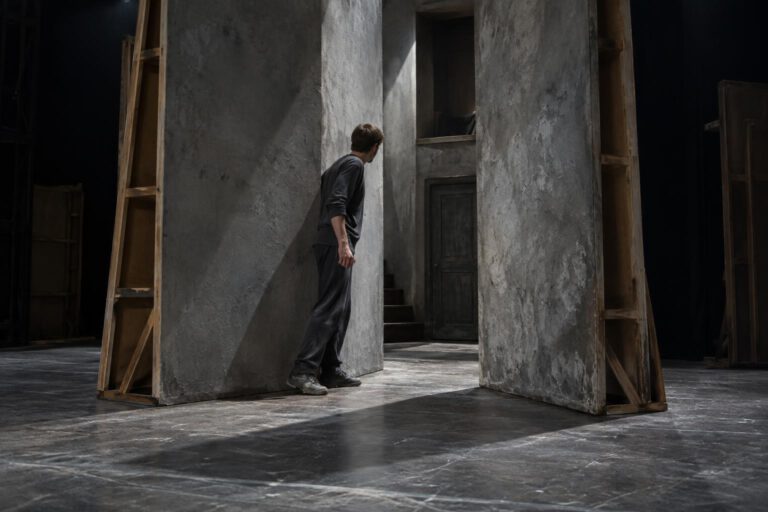
The direction, in turn, determines how this work on the text takes physical and spatial effect. Mondtag is also responsible for the set; Josa Marx for costumes, Robert Lippok for music, Hans Fründt for lighting and Sibylle Baschung for dramaturgy. There is no reliable way to describe in advance the spaces and sonic relationships that will emerge. That is precisely why the political programme should not be confused with its realisation on stage.
Who gets a dissenting voice?
Sebastian Zimmler plays Hamlet, Pauline Knof Gertrude and Marc Oliver Schulze Claudius. Pierre Emö takes on Ophelia and Fortinbras. This double casting connects two very different positions within the play’s structure. Whether it produces a commentary on intimacy and state power remains a question for the performance, not an interpretation to be imposed in advance.
What is likely to matter is whether the other characters’ perspectives carry weight alongside Hamlet’s claim. Whose present this ‘Hamlet’ speaks is not determined by new lines alone. It is equally determined by who is allowed to object — and whether the prince even hears that objection.
A preview is announced for 4 November; after the premiere, further performances in November follow on 7, 8, 14 and 15 November. No end date for the production’s repertory run is listed.
Original reviewed by the editors · 1 November 2026