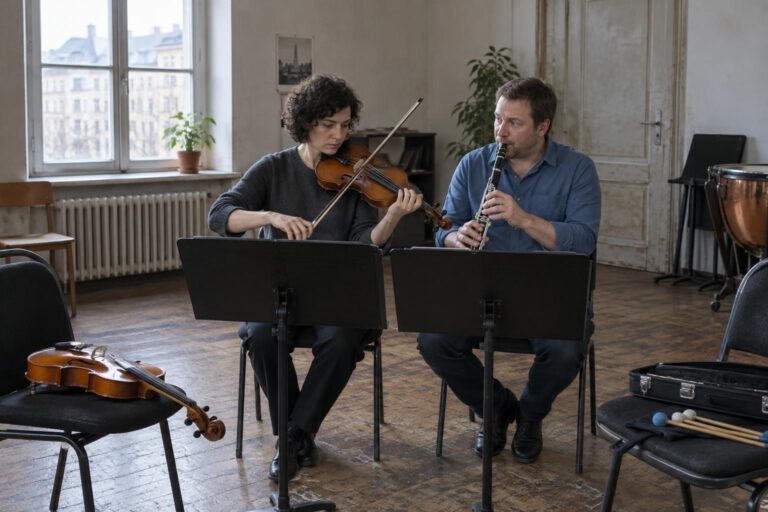
A string trio needs neither an orchestra pit nor a large stage. Three instruments must make the relationship between their voices audible: who leads, who responds, who keeps the sound open? In November, these small-scale forces offer a way into Henze’s wide-ranging output. His “Trio” of 1998 will be heard in Essen, and the early “Kammersonate” (Chamber Sonata) for piano trio in Gelsenkirchen. Both evenings form part of the anniversary year, but explore different stages in the career of a composer who never allowed himself to be confined to a single musical language.
This is not yet evidence that Henze has secured a lasting place in everyday concert life. An anniversary focuses attention; nurturing the repertoire begins when a work returns, is placed in the context of other programmes and is taken up by new ensembles.
Two works, two generations
The “Trio” for violin, viola and cello dates from Henze’s late creative period: its three movements are marked “Allegrettino”, “Adagio” and “Ländler”. The historical dance name alone signals a connection typical of Henze: older forms and gestures are not museum pieces, but material that can take on different colours in new surroundings. At the Folkwang concert, the work sits between Dohnányi’s “Serenade” and Schubert’s unfinished string trio movement; a new trio by Michael Em Walter will also be performed. Rather than treating Henze as an isolated figure, the evening places him within a sequence of responses spanning two centuries.
The “Kammersonate” takes us back to the post-war period. Henze wrote the piano trio in 1948 and revised it in 1963. Five short sections — from the animated “Allegro assai” to the “Epilogo” — give the piece a clear internal dramatic shape. In Gelsenkirchen, it encounters Beethoven and Schumann; the programme also includes the world premiere of a quintet by Stefan Heucke. The concert demonstrates one strength of the chamber format: a less familiar work can sit alongside familiar points of reference without the evening having to rely on its name alone.
Small-scale music and the work of building repertoire
Chamber music is not automatically easier to programme. Here, too, organisers need rehearsal time, suitable spaces, scores and parts, and musicians who can not only master a work’s technical demands but also communicate its distinctive qualities. At the same time, the forces are flexible: a trio can perform in a museum, a theatre or a conservatoire without requiring the organisational scale of an opera production. Smaller venues and ensembles in particular can thus keep works in circulation that might easily disappear between the great concert classics.
For conservatoires, passing on knowledge offers another opportunity. Students learn not just a piece, but also how to rehearse it, explain it and consider it alongside other repertoire. This is no guarantee of future performances. But every fresh encounter makes it easier to put a work on a programme again. Publishers and foundations also contribute by making information about works, performance materials and details of different versions accessible.
Henze lends himself to such contexts because his oeuvre does not smooth over contradictions. He wrote operas and symphonies, chamber music and works that draw on literature, politics or historical forms. His music therefore cannot be pigeonholed — and a single anniversary concert cannot represent it. Instead, the two November dates offer two specific approaches: a late string trio in dialogue with older and new works, and an early sonata in the shadow of great classical models.
After the birthday, what matters is the return
The centenary of his birth on 1 July 2026 provides an occasion, not in itself a legacy. Whether these performances become more than a seasonal focus will be decided in the years that follow: when ensembles return to pieces, conservatoires incorporate them into their work, and organisers present them not merely as a commemorative programme but as a musical choice in their own right.
The small-scale format can be a starting point. It does not make Henze’s music smaller, but easier to grasp: three or four voices through which we can hear how a work takes up and transforms tradition. It will only endure when someone wants to play it again — and a space can be found for it.
Original reviewed by the editors · 1 November 2026