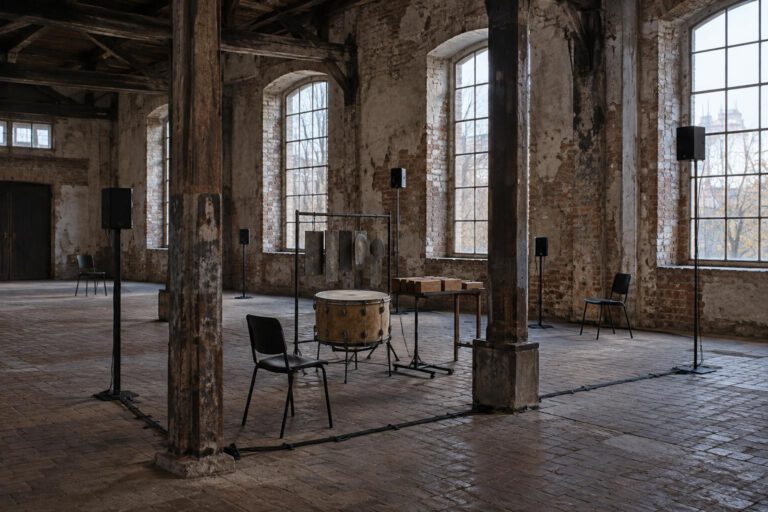
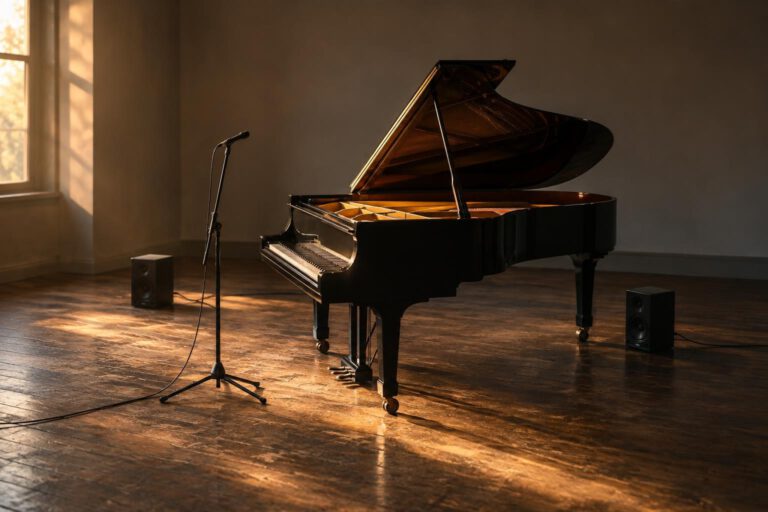
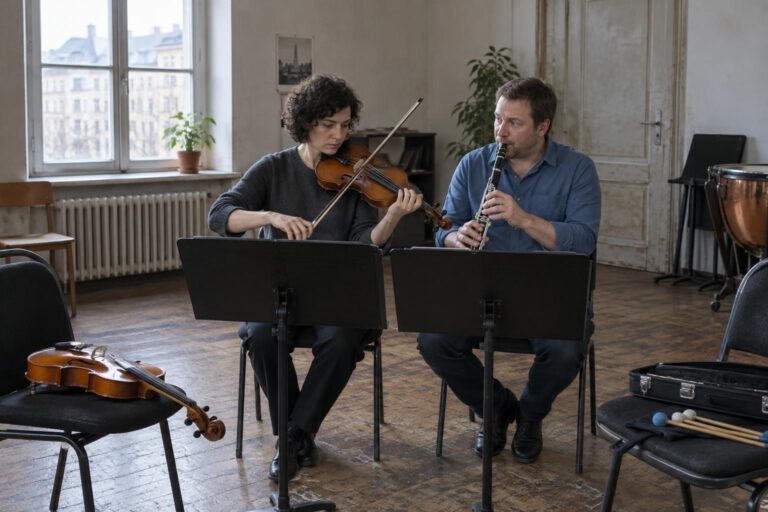
In concert, recordings of nature initially seem to promise immediate proximity: flowing water, chirping insects, a rustling forest. Yet between the location and the loudspeaker lies a chain of decisions. Someone chooses what to capture, positions a microphone, determines duration and volume, edits, layers or leaves the sound unchanged. So who speaks when nature becomes music? Not nature alone. The listeners, the technology and the form given to a sound also have their say.
Wien Modern makes this question a common thread through its 39th edition. Running from 30 October to 30 November 2026, the festival takes its audience along the Danube, into the forest, into the soil and towards barely perceptible insect sounds. Its scope ranges from Pia Palme’s work «Mit der Donau» (With the Danube), developed with Lisa Horvath, to Annea Lockwood’s «Sound Map of the Danube», an installation featuring recordings from more than 50 locations along the river.
A recording is already a perspective
In ecoacoustics, a soundscape is often described in terms of its sources: biophony refers to sounds made by living organisms, geophony to natural processes such as wind or water, and anthrophony to noises generated by humans and technology. These categories help to organise sounds. But they do not yet tell us what a recording means — or what is missing from it.
A microphone does not listen neutrally. Its position, directionality and sensitivity influence what is recorded; subsequent playback shifts the sound into another space once again. What was one sound among many in the forest can suddenly take centre stage, alone, in the concert hall. Conversely, musical treatment can obscure a recording’s life of its own: a bird call may then become a picturesque signifier of «nature», water a decorative backdrop.
This is not an argument against artistic intervention. Composition is selection and arrangement. What matters more is whether a work makes its mediation visible or audible — and whether it treats the recording as material without reducing its origins to a mere effect. A sound can be both an aesthetic form and a trace of a specific place.
From the field to the concert hall
The festival programme places different scales of listening side by side. In «Future Forest», Kirsten Reese works with field recordings from the Black Forest and the Lainzer Tiergarten; the production is being developed with Ensemble Recherche and scientific guidance from ecoacoustician Sandra Müller. In «Unter uns» (Beneath Us), Dimitri de Perrot makes the sound world below the earth’s surface the subject of a spatial work at the Jugendstiltheater. Jean-Luc Hervé brings insect sounds, percussion and spatial electronics to the Zacherlfabrik — a place where insecticide was once manufactured. Such connections to place prevent nature from appearing as a timeless idyll: the human history and use of a space are also part of its soundscape.
On 22 November, the Wiener Konzerthaus hosts the world premiere of «Schaum» (Foam) by Katharina Klement, this year’s recipient of the Erste Bank Composition Prize. Klangforum Wien performs the ensemble work under the direction of Bas Wiegers. Across her wide-ranging output, Klement works with composed and improvised, electronic and instrumental music; the organisers describe her practice as incorporating acoustic and social realities. This does not automatically make «Schaum» a nature piece. That distinction is particularly important: ecological thinking in music need not mean reproducing animal sounds. It can equally concern how sounds mix, how material is organised and who or what comes to the fore as we listen.
Listening is not yet protection
The idea of perceiving the environment not only visually, but as an interplay of sounds, has a longer history. From the late 1960s onwards, R. Murray Schafer and the World Soundscape Project made the acoustic environment itself a subject of research and design. The more recent field of soundscape ecology investigates how biological, geophysical and human-made sounds relate to one another and change. Music and science pursue different goals here: one can make meaning, ambiguity and form tangible; the other must measure and contextualise its observations in a verifiable way.
A concert is no substitute for an ecological survey. Even an impressive recording does not, on its own, demonstrate either species richness or the condition of a habitat. But it can shift our attention: away from humans as the sole point of reference, towards rhythms, layers and noises that are easily overlooked in everyday listening. Who speaks for nature remains an open question. Perhaps music’s task lies less in giving nature a voice than in revealing the conditions of our own listening.
Original reviewed by the editors · 31 October 2026