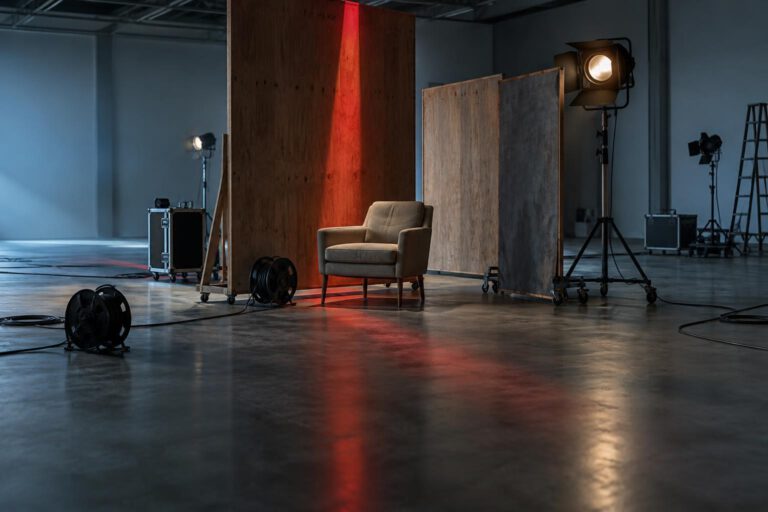
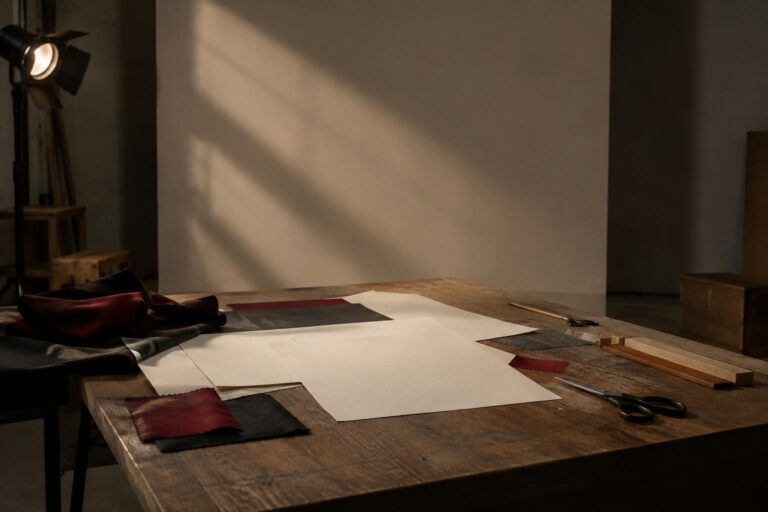
Before Ulrike Ottinger’s cinema reaches the screen, it takes its place between the covers of a book. Photographs, drawings and collected materials form a second version of the film alongside the screenplay. These are not retrospective scrapbooks but working tools: they allow colours, objects and characters to be discussed long before the camera rolls.
“Die Blutgräfin”, in German cinemas since 29 October 2026, offers an opportunity to consider this less visible side of her authorship. Isabelle Huppert plays the countess, Birgit Minichmayr her maid; a menacing book sets a chase through Vienna in motion. For this portrait of the director, however, another book is crucial: the one in which she prepares her images.
From painting to the moving image
Born in Konstanz in 1942, Ottinger worked as an independent artist in Paris from 1962 to 1969. She came to film in the early 1970s through painting, photography and performance. In 1973 she moved to Berlin. It was there that she later made her Berlin Trilogy, comprising “Ticket of No Return”, “Freak Orlando” and “Dorian Gray in the Mirror of the Yellow Press”. Documentary works such as “Chamisso’s Shadow” and “Paris Calligrammes” also form part of her oeuvre.
The move into film evidently did not mean leaving the other arts behind. The tangible nature of their continuing connection is documented by her archive, whose gradual acquisition was announced by the Deutsche Kinemathek and the Akademie der Künste in 2023: alongside films and photographs, it includes screenplays and workbooks, costumes and props. For Ottinger, the moving image has a material prehistory.
A concept becomes a collaborative undertaking
In addition to the screenplay for “Die Blutgräfin”, Ottinger compiled a book of materials, she explains in Filmdienst. This served as the basis for detailed discussions of costumes, accessories and sets. By her own account, she spent a year working on designs, materials and colours with costume designer Jorge Jara, and six months on preparations with production designer Christina Schaffer.
The work was spread across two pavilions on Vienna’s Otto-Wagner-Areal: costumes, hair and make-up in one, sets and props in the other. An old carriage was restored, a boat built. In an interview with the Austrian Film Institute during preparations, Ottinger was already listing the crafts involved, from joinery to bookbinding and engraving. Her visual conception needs people who can work with materials and find technical solutions.
This also challenges the convenient notion of the solitary artistic genius. Ottinger’s authorship does not lie in making everything herself. It consists in determining the relationships between things. In the same interview, she stresses that every object and its colour have significance for her visual language. In this way of working, a costume is not the final covering for a fully formed character, but part of that character’s development.
Precision under pressure
Lengthy preparation, however, offers no protection against the constraints of the film industry. As early as December 2024, Ottinger told the Film Institute about budget-driven script changes and the loss of locations. A cut required connections within the screenplay to be re-established. Behind the visual conception, then, lies an ability to rework it.
For “Die Blutgräfin”, Martin Gschlacht took charge of cinematography — the first time, according to Ottinger, that she had not operated the camera herself. Speaking to Austrian Films, she describes planning the shots together, including differences of opinion. “I always start with the images,” she says there. Yet these images must stand up to collaborative scrutiny. Her cinema takes shape in front of the camera; the work on it begins with collecting, drawing and making decisions. And it continues when others translate the concept into fabric, wood, light and movement.
Original reviewed by the editors · 30 October 2026